

The Philosophy of Flat Photography
Pictures that remove uncertainty and soften the hard edges of reality.

I like my images to be dead flat. I don’t know why or when this became important to me. I just noticed a trend in my photos over time. The shots that made me feel most satisfied and at ease were the ones that looked almost 2D.
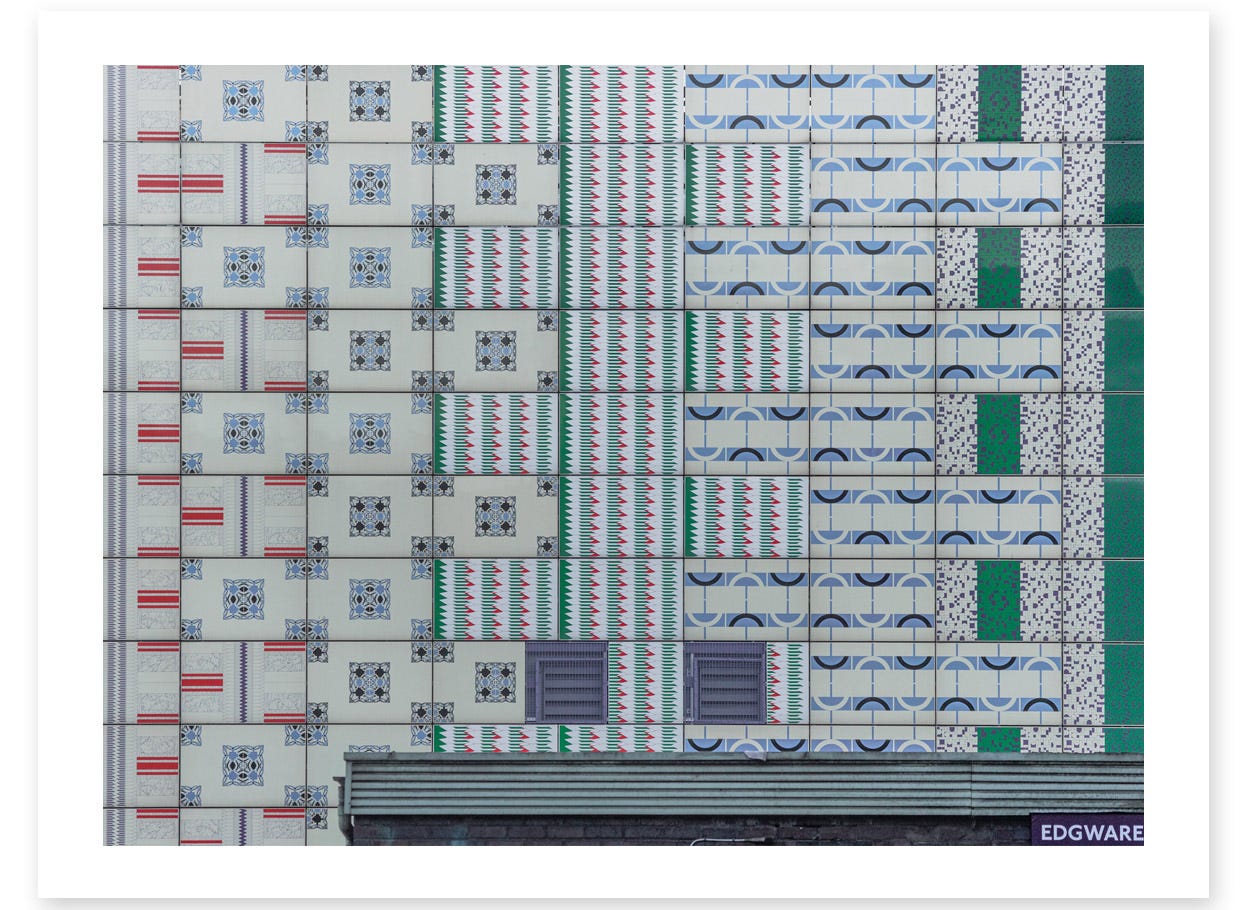
‘Flat Edgware’
This is an image I took earlier this year.
The scene was bleak and messy outside of the frame. I was leaning against a sharp railing, on a busy thin pavement next to a raging dual carriageway. Cars screamed past constantly and everything was grey and polluted. My fellow pedestrians looked busy and annoyed. I was a scrawny annoyance. To get this shot ‘flat on’ I had to angle myself awkwardly against the railings.
I was overly aware of my camera and my sixth sense was scanning the periphery for anyone wearing a balaclava or riding an electric bike while I tried not to block the path. Yet for a moment I zoomed in on a small window of symmetrical calm.
I framed the shot to leave out the mess, noise and ugliness. There is much more to the building, outside of what I framed here. The relentless pollution had created slimy, dirty streaks. Above the building the sky was an ugly grey dusk. Below were thick grey rails to stop cars crashing into each other. Under this was a lattice of grey roads.
It was an ugly, noisy uncalm environment. It doesn’t matter how interesting a subject matter is. If it’s set against a mucky or jaunty background my brain fusses over it.
By the philosophy of flat photography I think I mean, more broadly, the flattening of chaos. The softening of noise and of honing in on calm.
All hail the planimetric
There’s a word that in part describes this aesthetic…
Planimetric.
The film theorist David Bordwell describes the planimetric aesthetic in film and photography as having “the camera lined up perpendicular to a back wall or lines in the setting”.
The goal is to produce images or scenes that look intentionally “flat”.
In the mid nineties Wes Anderson’s films burst onto the scene like a great origami firework. I was both thrilled and annoyed. Thrilled that entire films were being made with this aesthetic. Annoyed that it would look like all of my images were trying to rip off Wes Anderson.
It also made me realise that there were others like me. Whole photography movements started to form around Wes Anderson’s style.
(There’s even a book and franchise called Accidentally Wes Anderson. People collect, share and curate images that look like they could be a frame from one of his films).
His films have only strengthened my resolve for the 2D aesthetic. They celebrate imagery that hugs parallel lines and perpendicular framing.
What is this attraction that Wes, myself and thousands of others have to the flat aesthetic? To this mathematical, cosy neatness?
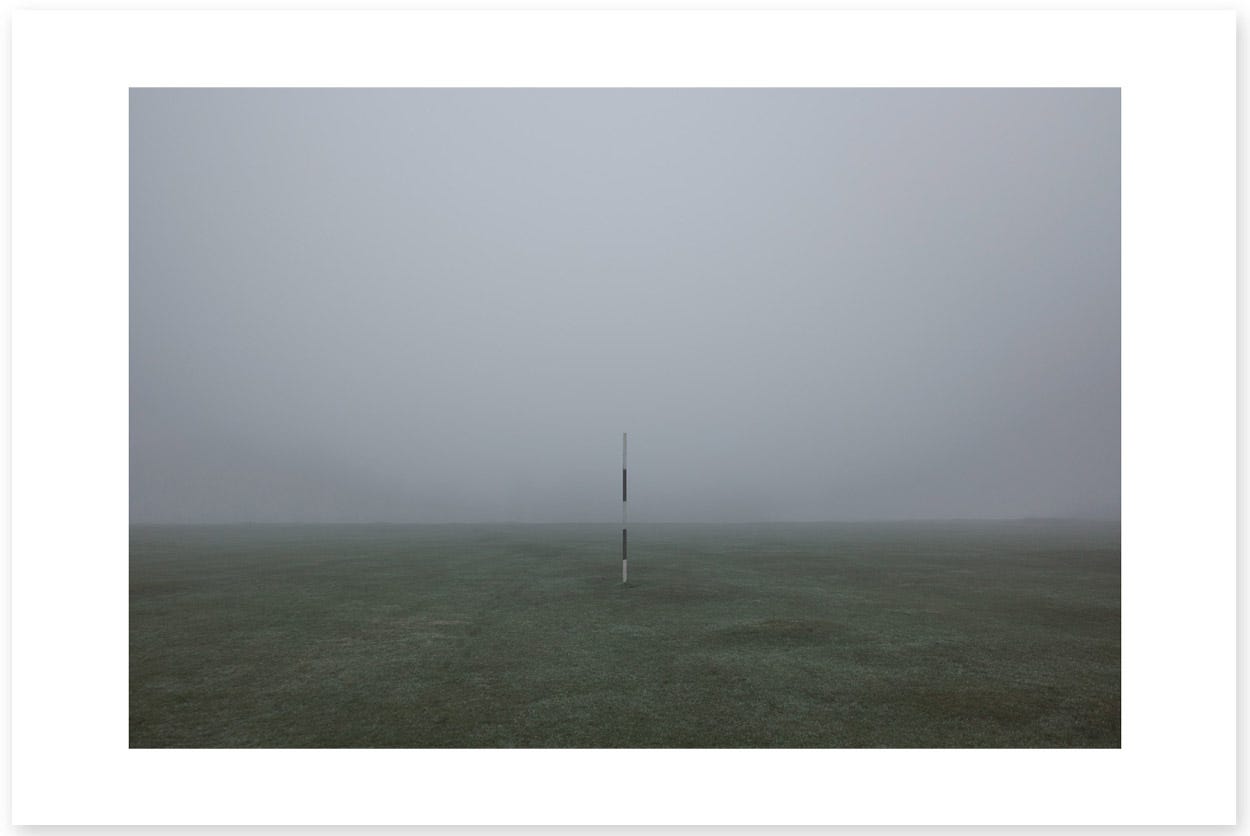
‘Flat Golf’
The philosophy of flat photography
I think about what the draw is with flat photography.
Is it something that appeals to certain brains? Is it a tonic for those of us with swirling, haphazard minds?
My own feeling is that the flat, neat framing provides a sense of calm and order.
This can only ever be speculation because I cannot ever know what it is like to be in another person’s mind.
Maybe all minds are like mine, maybe all minds are the opposite. Maybe, like with most things, we sit on a spectrum. Shifting variables that expand and contract throughout our lives.
Based on conversations I’ve had with others, I get the sense that my mind darts and ruminates a little more than, say, the average. If this is the case it’s neither a good nor bad thing (it’s both). It’s also the only reality I have.
I have little practices that I’ve developed, over the years, to calm my brain when it buzzes and whirrs. They typically involve the usual:
Walking in nature, getting lost in a good book, looking out over the horizon, sauna, spending time around kind people, hiding electronic devices from myself.
They probably sound a bit podcast hacky but they work. I’ve also developed practices within my creative work, including my photography.
Part of this is the slow, mindful process of editing and curating photos but it’s also how I photograph a scene and what I enjoy when I look back.
This is where the flat, level, dead straight photograph comes in.
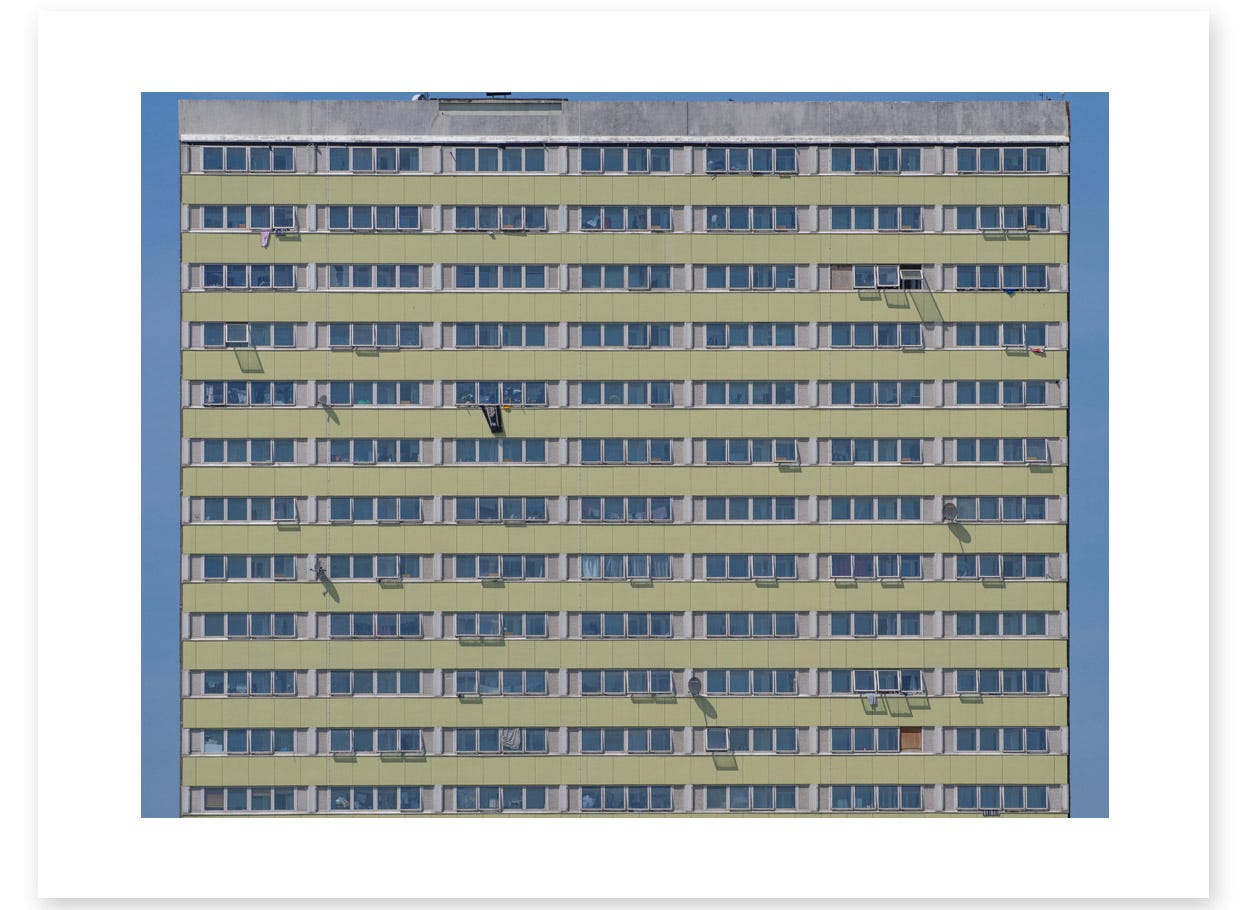
‘Flat Flats’
Unlike the first image I shared in this piece the elements sitting outside of the frame in this shot (the green block of flats) weren’t ugly. The sky was blue and the foreground grass and trees. But they were still distractions.
It was a comfortable shooting experience this time. I wasn’t contorting my spine against a railing or dodging pedestrians. I was sat on the grass, calmly, unhurriedly changing lenses and framing the scene in my own time.
Two different images and shooting experiences but both, I think, striving for the same thing. Calm and simplicity.
For me when an image has some internal order to it and some of the chaos intentionally left out of the frame, it takes on a calm, zen-like quality.
The overwhelming schema of three dimensions… and all the goings on in the moment, are blunted and soothed in a bed of tidy, ordered comfort. It brings relief.
Happily drowning in the aesthetic
I’m going to go off on a tangent now, but bear with me.
I think this is the kind of relief that Schopenhauer talked about when he discussed, in his way, the human condition and the nature of existence.
Specifically what he called ‘will’ or what could be understood as ‘striving’ (I’ll use the word striving) that drives our behaviour... and that drives nature’s behaviour.
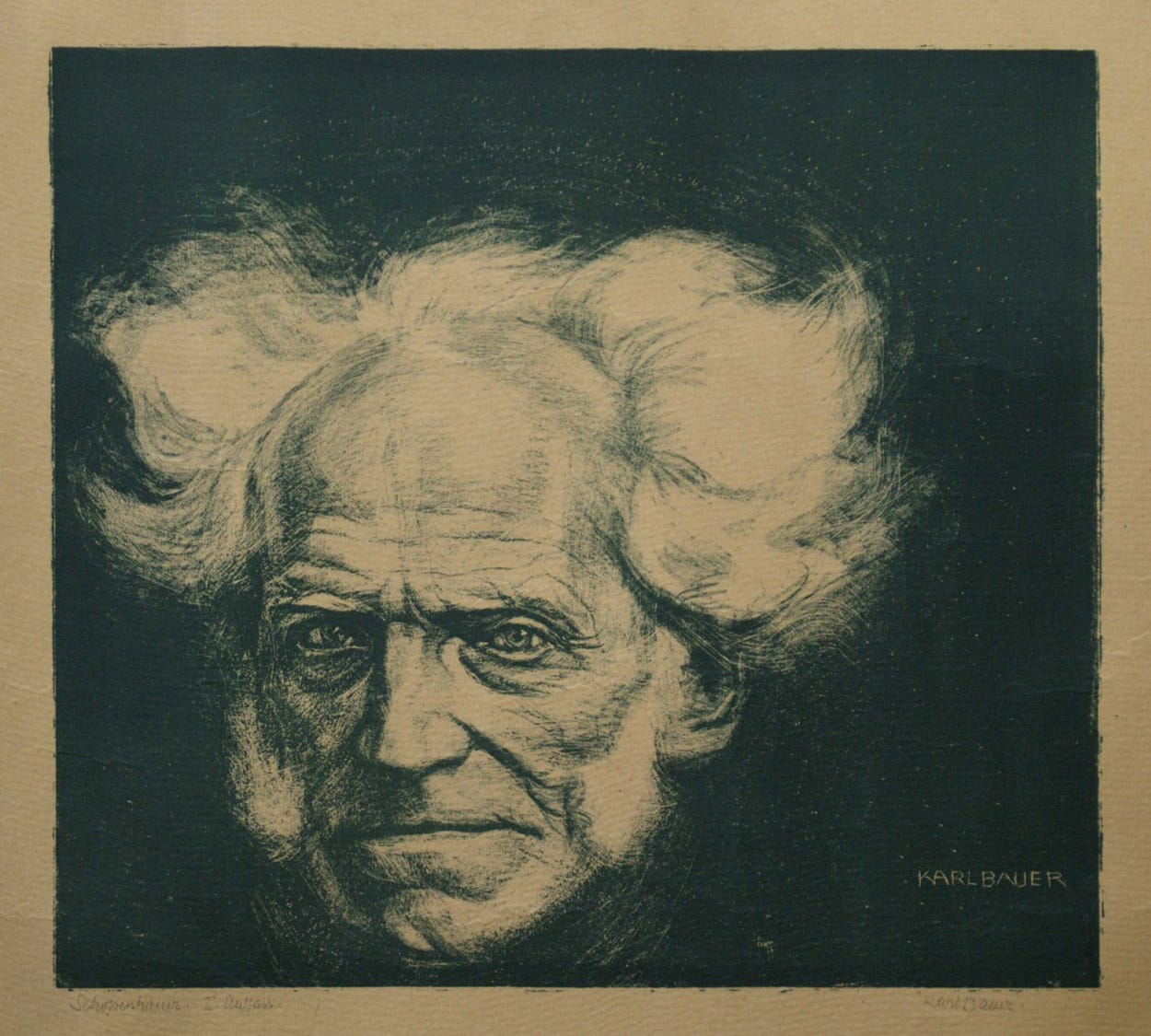
Portrait of Schopenhauer by Karl Bauer
What does he mean by striving?
The drivel on most Social Media platforms would have us believe that striving is a chest pumping Wolf of Wall Street -esque drive to ‘succeed’.
That might describe a soiled, end game manifestation but that’s not it.
It is the unconscious striving of all things.
It’s worms drawn to moisture under the ground. It’s cells dividing and tectonic plates shifting. It’s the need to go to the toilet or scratch your chin. It’s the microbes in your gut multiplying. The swipe right on Tinder. The deciding, after trillions of imperceptible mind-shifts, to leave your home city.
It’s everything. The incessant movement towards. The buzzing, vibration of atoms. The constant inertia. Everywhere always in flux.
If this all sounds tiring and stressful that’s because it is. Existence is extraordinary and relentless.
Momentary release from the chaos
But there is respite. One release from the relentless surging, Schopenhauer believes, is in the rare moments where we truly experience, and get lost in, the aesthetic.
The word aesthetic is often banded around clumsily, usually by ad agencies. By aesthetic, we’re not talking about looks or branding. It’s about beauty - intrinsic, emergent beauty - in art forms like music, painting and theatre.
It’s being totally and utterly enmeshed in a piece of music so that you are the music and music is you. Everything energy, no differentiation.
For that brief moment you experience - and become part of - life’s wave forms. You become part of the ‘noumena’, the thing behind the thing. Free from your tangled, fleshy cage. Free from the inertia and part of the whole.
Any great work of art - natural or otherwise - Schopenhauer believed, can have this effect. Being utterly absorbed in a painting allows you, for a few moments, to transcend humanness, to transcend aches and pains and ruminations. The pathos of theatre, the hypnotic beauty of a butterfly wing on a dandelion in a field in late September.
Maybe, for me and others like me, one of the trillions of pathways that can connect with the aesthetic is the calm and order that flat photography provides.
I don’t live in a particularly ordered way. My photography is not neat or planned and yet there is control, maybe that’s the word, control.
When I see something that I want to photograph I feel compelled to neaten it. To put it in a box and protect it.
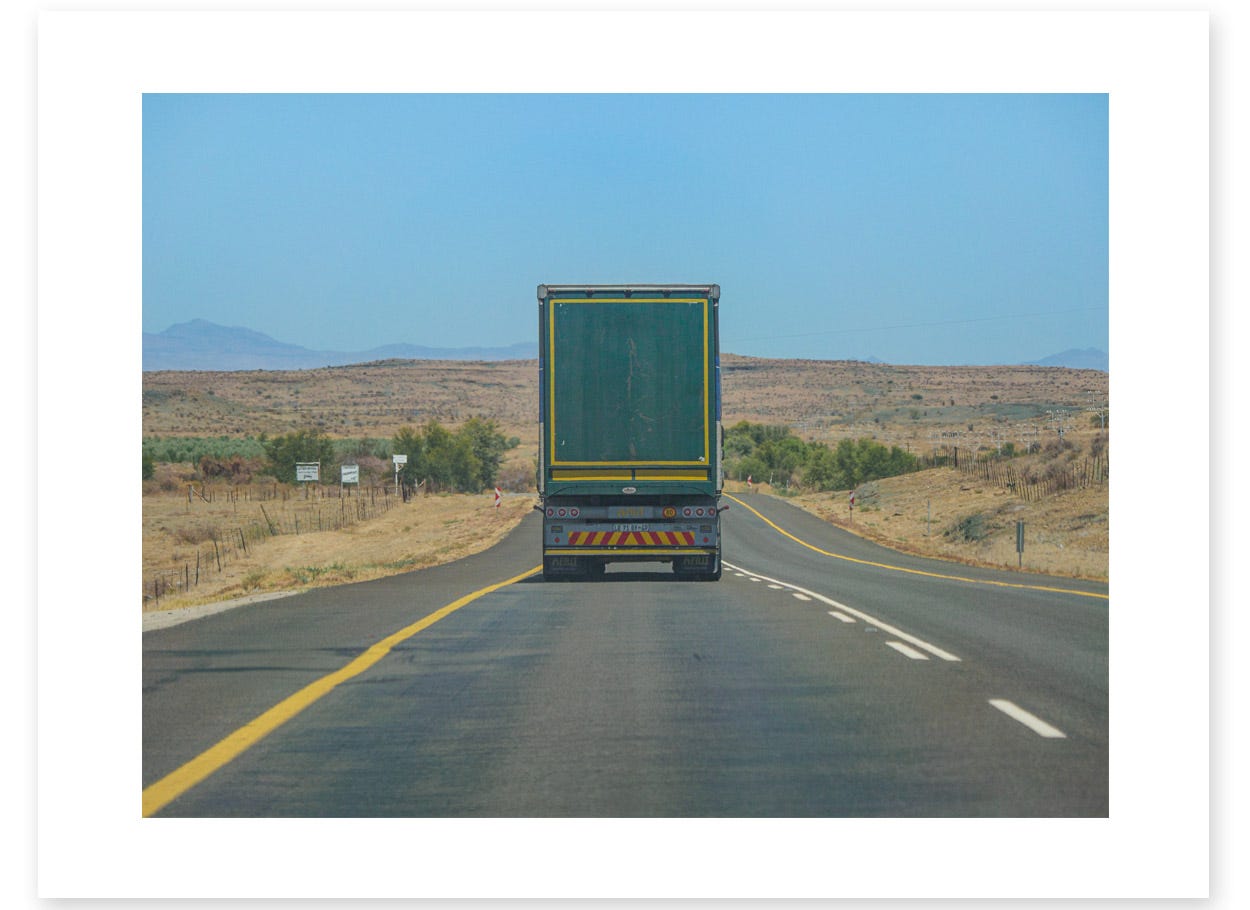
‘Flat Lorry’
“Always be knolling”
My friend Jono taught me a word called knolling. He noticed me doing it one day at a table and shrieked “You’re a knoller!” He then showed me this video on YouTube: Always Be Knolling.
Knolling is the act of neatly aligning things in front of you. Arranging objects in parallel lines or at right angles. I don’t always knoll but I often knoll. Usually absent-mindedly. Some people chew pen lids, I arrange salt and pepper pots.
It’s a curious trait. I would understand it more intuitively if I was someone who needed to keep things obsessively tidy, but I don’t. For most of my teenage years my bedroom looked like an explosion. Until I met my partner so did my flat, then our house and… actually I’m still messy.
I think all humans, even those of us who are leave-socks-on-the-floor type people, need respite from chaos. We need to have some feeling of control.
Brains like mine - and perhaps yours (if this resonates) - find respite by making sense of what’s in front of us.
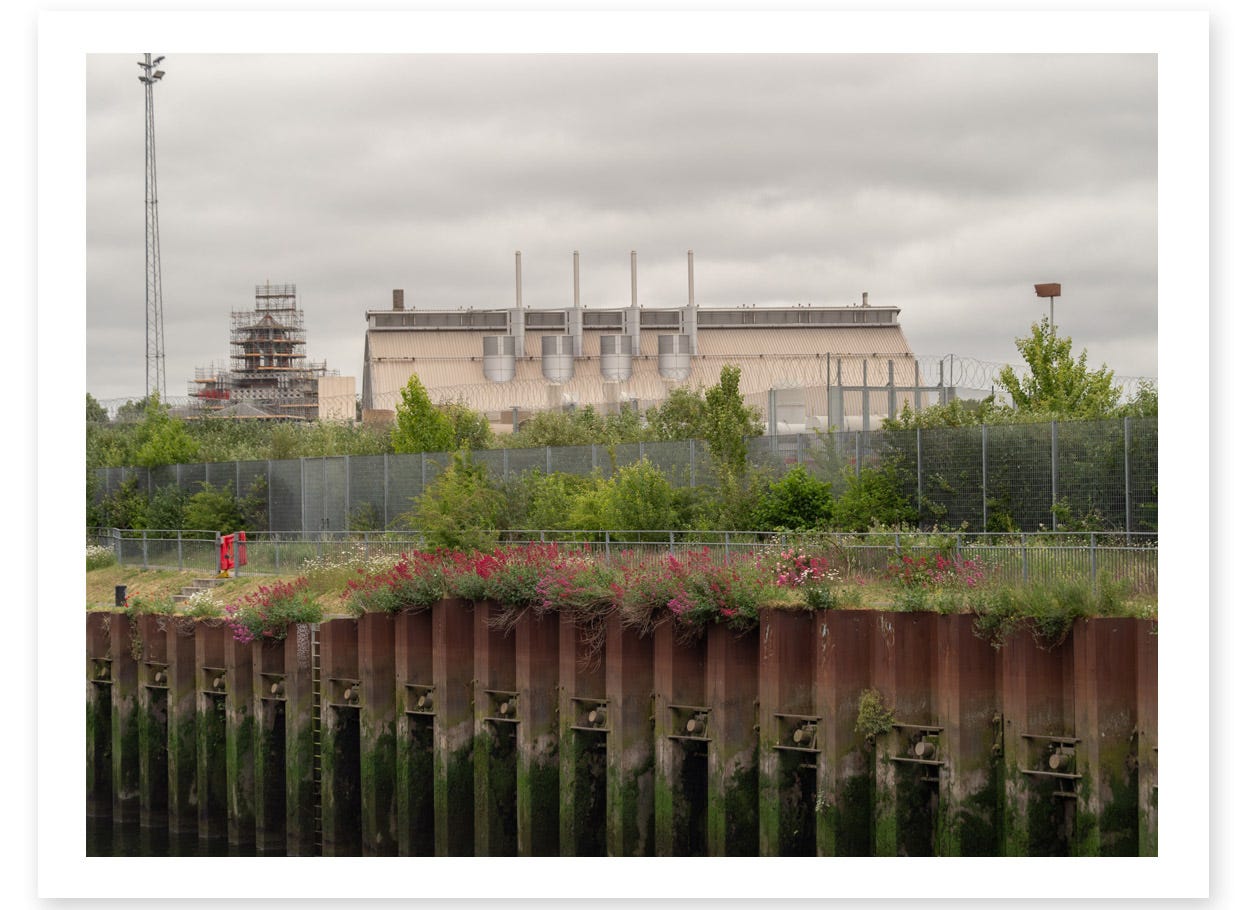
‘Flat Canal’
We try to create localised order. I think this manifests in different ways for different people in different environments.
For me it’s the intentional framing of a photograph. It’s also absentmindedly framing the small area of the table in front of me with my hands, as I knoll pencils and condiments in parallel lines.
For someone else it’s the neat, millimetre perfect cross-stitch, the careful construction of a bird box, or the subconscious artistry of applying eyeliner.
Windows within windows
It occurs to me that when I knoll, or when my aunt cross stitches, or my niece applies eyeliner we are working within windows we’ve constructed.
There’s the embroidery window where the cross stitching takes place. There’s the eye-shaped window which becomes the canvas. There’s a window in front of me, on the table, as I unconsciously align the knife and fork at perpendicular angles.
Any mess to the left and right of these windows is cropped out because we choose not to focus our attention on it.
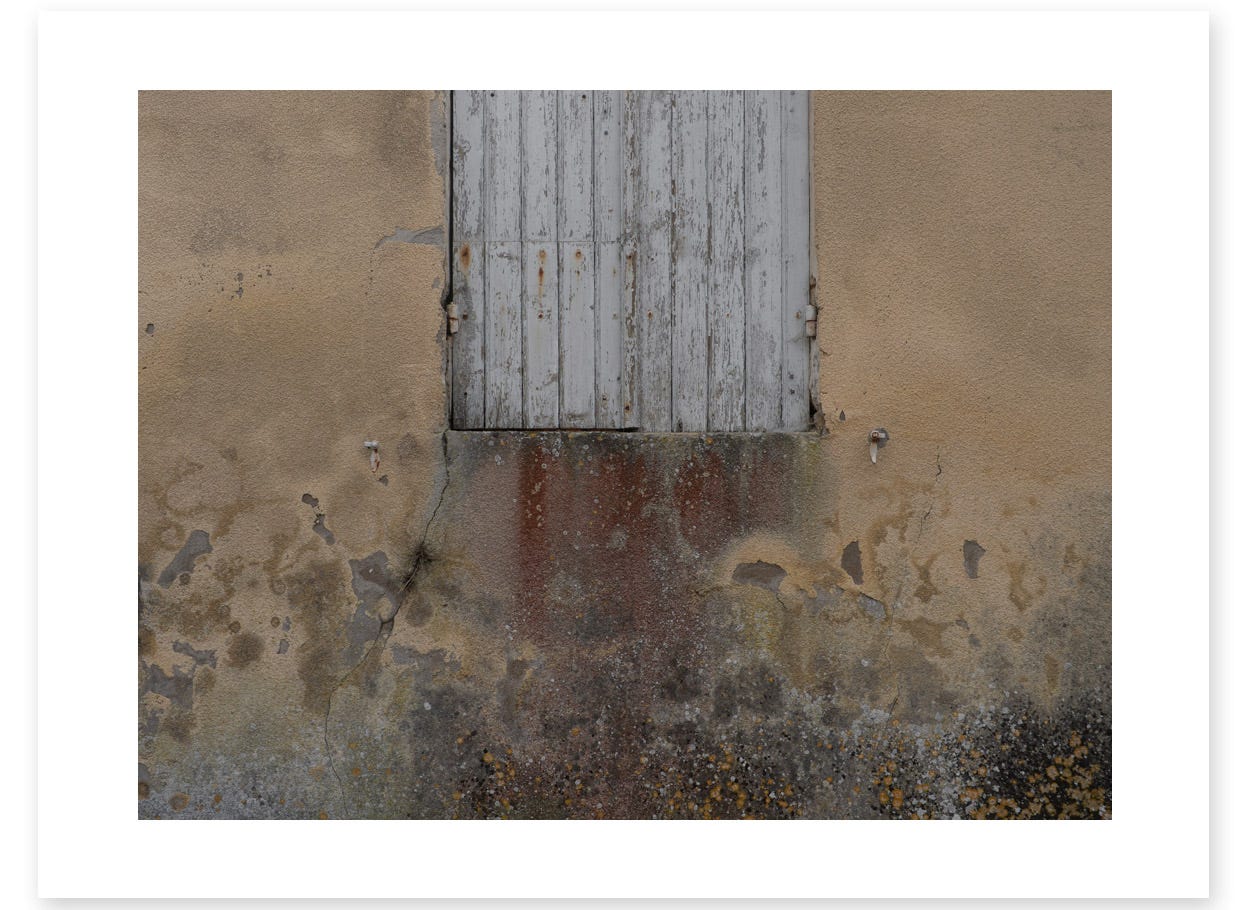
‘Flat Window’
In the photograph above (some window shutters I gawped over in Bordeaux) there were messy elements just outside of the frame. Tufts of grass below, vines to the side, the awkward edges of the building and an ugly plastic white vent.
I didn’t want any of this. I wanted to feel as if this beautiful, imperfect French wall might go on forever.
Maybe that’s what I’m doing when I photograph. I’m arranging the world within the window of my viewfinder or screen. A little world I can control and make sense of. I’m trying to collect beautiful fragments.
We have gone deep into the rabbit hole now so I’ll try to return to the premise.
The philosophy of flat photography, is for me, about seeking calm and control. It’s finding little windows of sense within the chaos.
I’m interested to hear from you and other artists, writers, photographers and creatives.
Have you noticed any patterns like this?
It doesn’t have to be straight lines or curved lines. It could be an attraction to certain sounds or colours. It could be how you edit and rewrite your words. It could be the materials you work with.
Have you thought about what it might represent, what it might be drawing you to, or helping you escape or find?
I enjoy thinking about this sort of thing. Flat photography, declutter and the joy of knolling feature in my photography and I’m happier for it.
There are other rhythms, moods and stylistic dances I’m drawn to but this always struck me as a curious one.
Maybe we are all wired, from birth, such that our tastes and predilections are predetermined. Maybe we are in part shaped by our traumas and environment.
Maybe life just ‘is’. We are the bees constructing hexagonal hives for no other reason than it is what is done and what we must do.
Thanks Ergun, great stuff. I think you've been able to articulate well something I hadn't quite realised or put my finger on here. The subject (i.e. laundry, for example) can by its nature be a messy, 3D. Sometimes even ugly by conventional standards. Ordered elements and lines can give it some framing and the space for it's own kind of beauty.
Interesting article. I'm not sure that I saw all the images here as "flat," although the image with the tiles and the bench and that of the apartment bldg definitely - only because to me those felt like they emphasized pattern and geometry, rather than just orderliness. The need to make sense of things by putting them in a specific order or framework is definitely something that is natural to humans (I can't speak about bees, etc. as I am not a bee). Whether literally as in objects, a map from here to there, or more abstract as in an essay with a particular structure leading from a statement to a conclusion, the aim is to focus intently to understand something very specific. I read an article today about how writers do this by eliminating all the distractions that they can in order to focus on their writing. Apparently, our minds are wired to be sensitive to many things at the same time, so focusing deeply takes effort. So to me, that is what you are doing with your photos, it is a way of focusing deeply to understand a specific thing and put it in the spotlight to share with others.