

Abstract Nature Through a Tiny Porthole
The art of leaving things out

I’ve become interested recently in depicting complex natural forms through simple, abstract frames.
Extreme close-ups, surreal lighting, deep shadow. Taking a shifting, infinite sunset and distilling it into a handful of shapes and colours.
A blood orange sun looking like a pixelated arcade machine graphic as it sinks behind a hill.
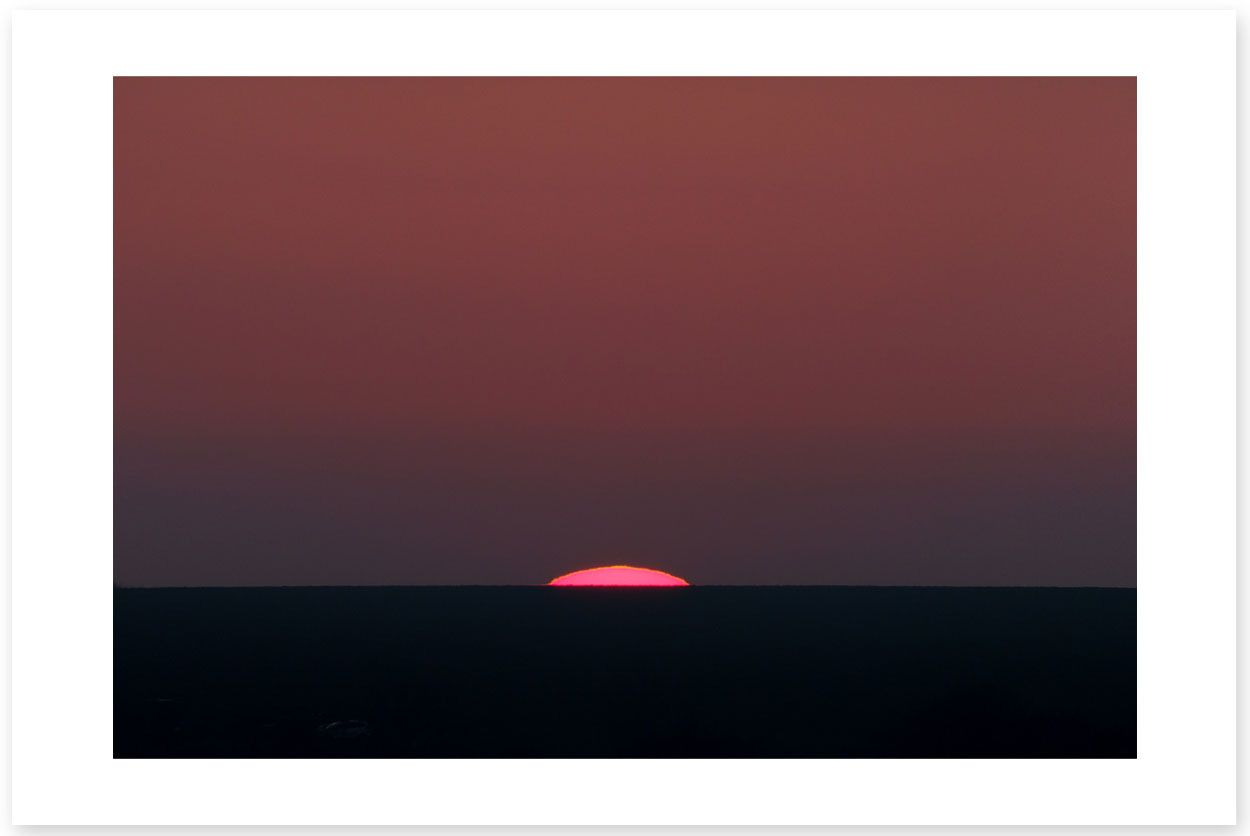
‘Abstract Sun’
Now that I’m seriously focusing on this idea, which I just thought of in the shower which came to me as I contemplated the mystery of all things, I’m frustrated.
I have lots of photos that would fit the brief but don’t have easy access to all my old hard drives since moving out of the city.
Someone (I’m looking accusingly at myself here) hasn’t unpacked all the boxes.
So I’ll focus here on some images from the last few weeks.
There’s a pleasing discipline in that and I’m learning to love these sometimes deliberate, sometimes accidental (usually arbitrary) restrictions on the curating and editing process.
The idea is to make familiar subjects less familiar while still trying to capture an aesthetic.
Fine tuning perception
Photography, as a medium, gives us the ability to hone in on a thing. Sometimes a thing within a thing.
We can exclude from the frame what we don’t want the viewer to see. Anything that might complicate, distract or evoke a different emotion.
I think we can - and should - use this to fine tune perception.
To try to capture a specific mood or meaning. Sometimes a meaning that might not have seemed present at the time. The faintest whiff of a signal.
A feeling of total silence and mercurial calm you noticed. One element. Flaking paint on an abandoned window, framed by an ancient-looking vine.
Even if a security guard was screaming “get out”. Even if the wind was howling that day… that calm you perceived was still present, you captured it. The thing that would have otherwise gone unnoticed, lost in the noise and fog, preserved.
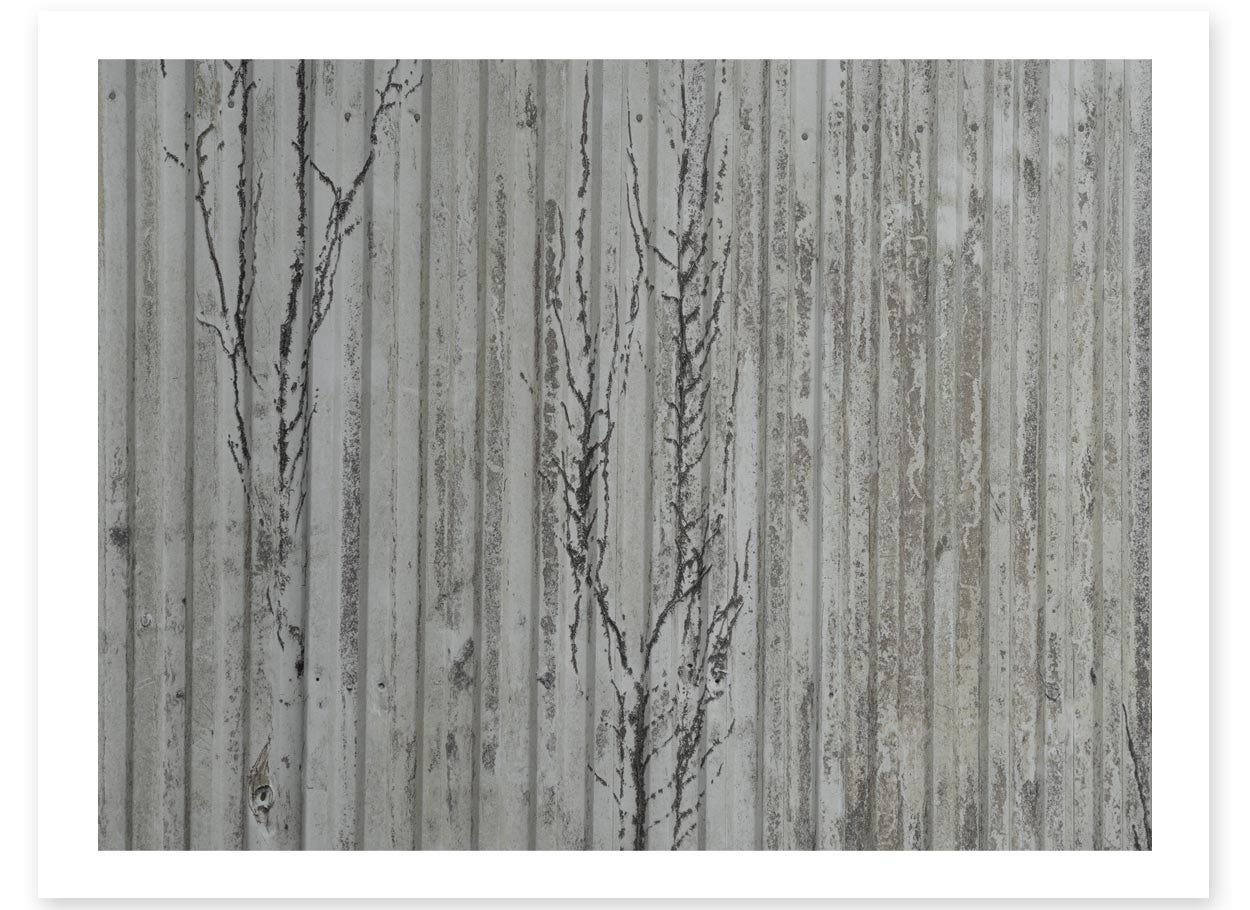
‘Corrugated Vine’
Stand back from the photograph above and you would see six or seven ugly cars and behind them a huge complex of precariously balanced corrugated iron panels.
I’ve shot this carpark before, from a distance, because it’s an odd scene.
But when I looked this time I noticed the ghost of the creeper. The gentle, weaving line work nature has done on the otherwise uniform panels.
Photography is as much about what you choose to leave out of the frame as what you include in it
That’s why the old photography adage ‘get closer’ is so enduring.
Another way of putting it might be to remove clutter from the frame, remove edges.
Remove any external influences vying to get attention or confuse things.
So many potentially great photographs that capture something incredible have no impact because there’s too much going on.
When we look at a photograph we see a much smaller representation of the world.
Sit in the front row of the theatre and the characters are almost life size. Look at an image on an A3 print, Polaroid, or (gasp), a phone and the characters are ant like.
It’s useful to understand and play with that.
Watch the sunset in the most naked way possible, with our actual eyes, we focus our attention. We are drawn to the elemental.
Everything around the sun is still there but we are engaged and hypnotised by its last dance.
A photograph can convey drama, simplicity, harmony, fear, sadness, joy or beauty. Any given moment can contain any one or some or all of those things.
We see whatever the photographer decided to keep within that particular frame.
Ugly cluttered backgrounds or elements that don’t create symphony or rhythm can be jarring.
They can make otherwise beautiful moments messy and uncomfortable.
Beyond the obvious
There are ways around the photos-aren’t-life size issue. We can print big, or insist that only tiny people view our work.
Or… we can use zoom lenses to make smaller elements of a scene larger…
Macro photography to visualise tiny worlds that were otherwise invisible.
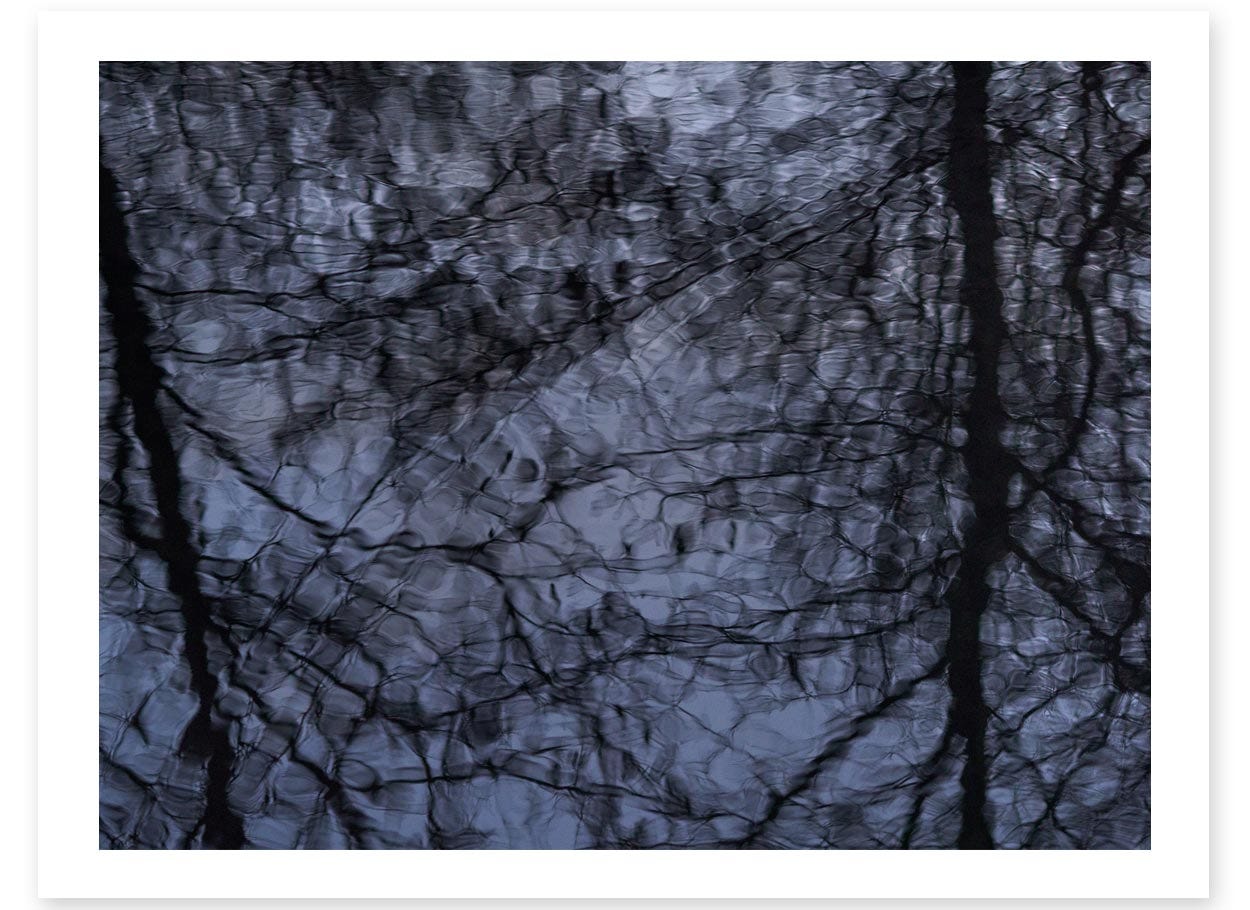
‘Glassy Geometry’
A few months ago I was shooting discarded rubbish and clambering into underpasses in London. Now I’m noticing strange reflections in the water.
When we start out with photography often the instinct is to whip out the camera and click vaguely in the direction of things. Spray and pray.
We get excited. We forget or don’t realise that the camera doesn’t capture life size. It doesn’t capture those moments before and after the frame. It doesn’t do smell or touch or fear or ecstasy.
It doesn’t have the brain’s ability to harness attention and to focus on that one beautiful or surprising thing.
The photographer has to do all that, while understanding that they are using a medium that only captures light for a millisecond in a single tiny, sliver of a space.
The image that has energy and longevity is the one that captures a magic that whispered, almost noticed.
Sometimes you get that tiny thrill. You look at the back of your screen. You nod smugly and inwardly to yourself and think, ‘got it’.
Then you get it off your SD card afterwards and it is ugly. The parts of the photo you remember your mind’s eye focusing on are overshadowed by some ugly thing you hadn’t noticed in the background. An overhead cable or a red car jars.
The periphery becomes the subject.
That’s why we have to ensure that the subject dances alone or in symphony with other elements that complement or exaggerate it.
So this mini story book is a celebration of that. Of using light and framing to such an extreme that the image itself almost becomes an abstraction.
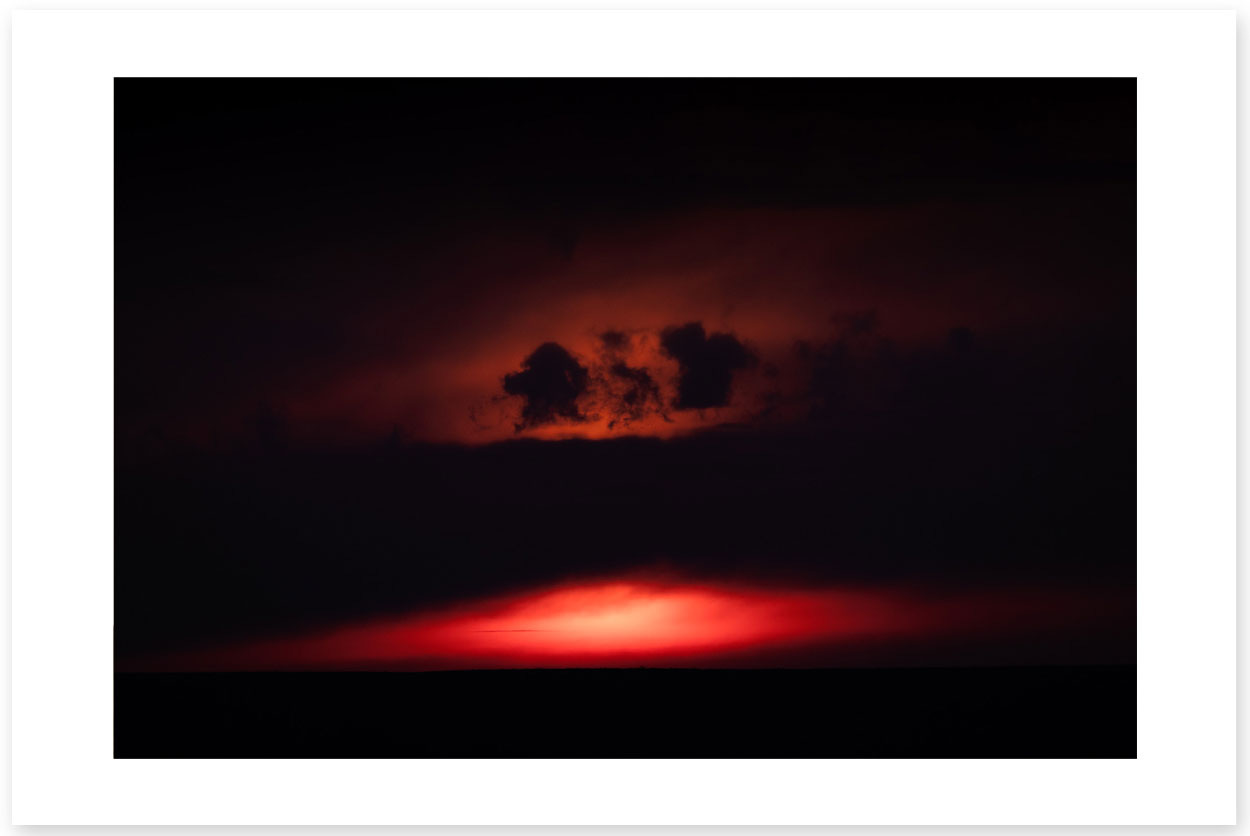
‘Sun Face’
I like this one.
I like it particularly because my partner and I went for a sunset walk that evening.
We walked to a spot that I’d been wanting to show her. It’s a place I sometimes sit and watch the sun go down.
It was a really overcast day so I wasn’t expecting much. A yappy dog kept sprinting over and scratching my trousers.
But, for a few minutes, the sky turned perfectly pink in one small area. It was also dead straight and at a strange angle. Like a hexagonal ruler emerging from the left.
If I had been 50 metres higher and further forward and had a 70 foot lens I think I could have got an interesting shot of it dissecting the sky. Instead I took some boring images I’ll never look at again.
But we sat on the bench and watched it for a little while longer until my partner announced that this was a ‘mediocre’ sunset.
So we decided to leave before it got too dark. But I kept on jerking my head back, as we walked, to see what the sun was doing.
You never know with sunsets, they can shape shift unexpectedly.
One of my best tips is to linger for that last 10 minutes - even if it’s looking hopeless. Strange things can happen as the sun ducks under the horizon.
And that’s exactly what happened.
The clouds, as if rushing for last orders, arranged themselves in a way that the sun became a dimmed orange light bulb.
It squashed into a flaming, luminescent yolk. Awe turned to laughter as a couple of cloud eyes formed above. Beautiful and ridiculous.
I spent a couple of minutes unpacking my stuff again and caught the shot above.
I was interested in the abstraction. In the majesty of nature and of the sun, giver of life, reduced to a child’s drawing of a face.
So this is the story of sunface. A sunface that followed us home.
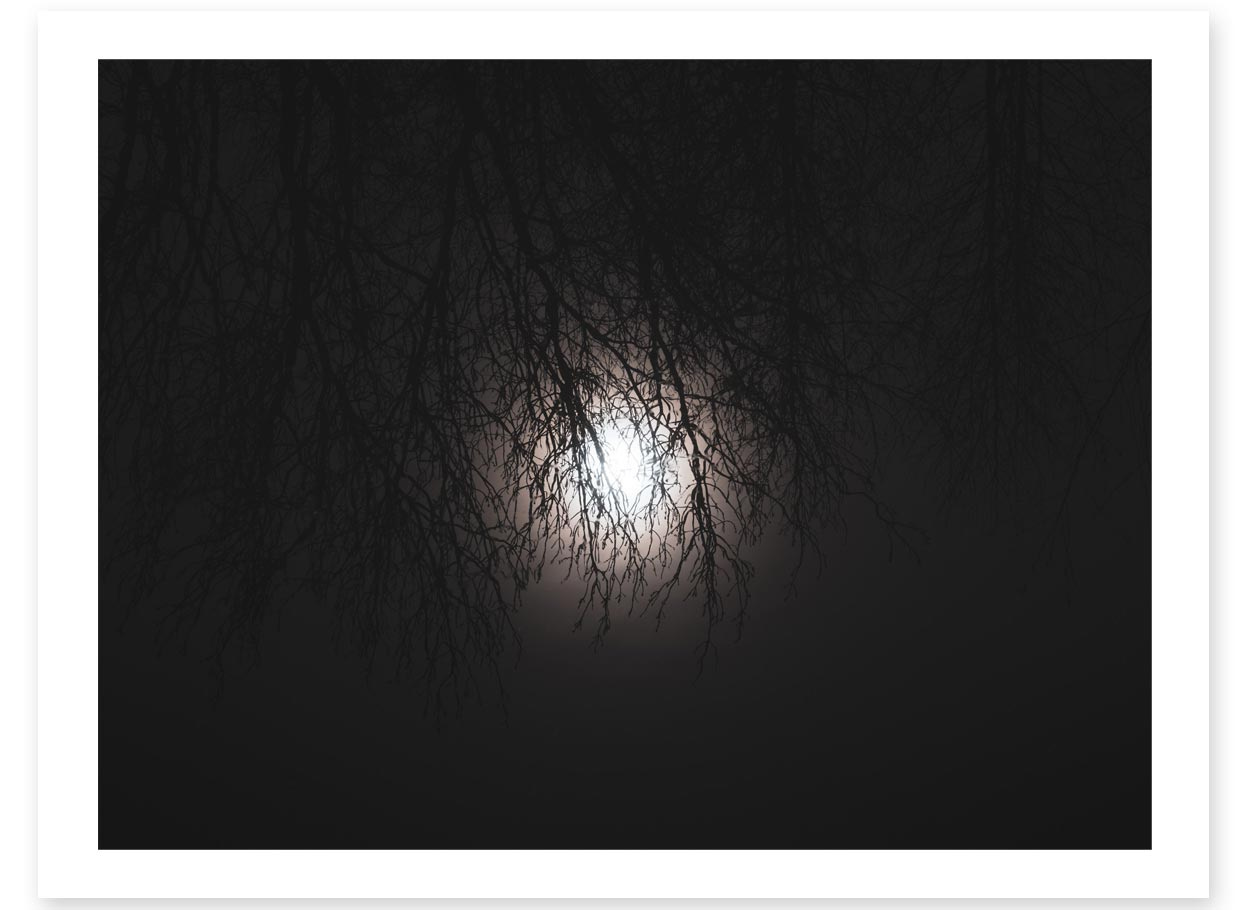
‘Tree Orb’
This one involves a dimmed, gentle version of the sun.
It was overcast but I was walking at a much lower altitude by the water when I noticed the trees had created an inky reflection.
The sun was almost in frame so I walked around a little until I liked the positioning. I then tried to frame it so that there is no muck outside. No broken reeds or crisp packets.
With all these images I want the impact to be the thing that impacted me.
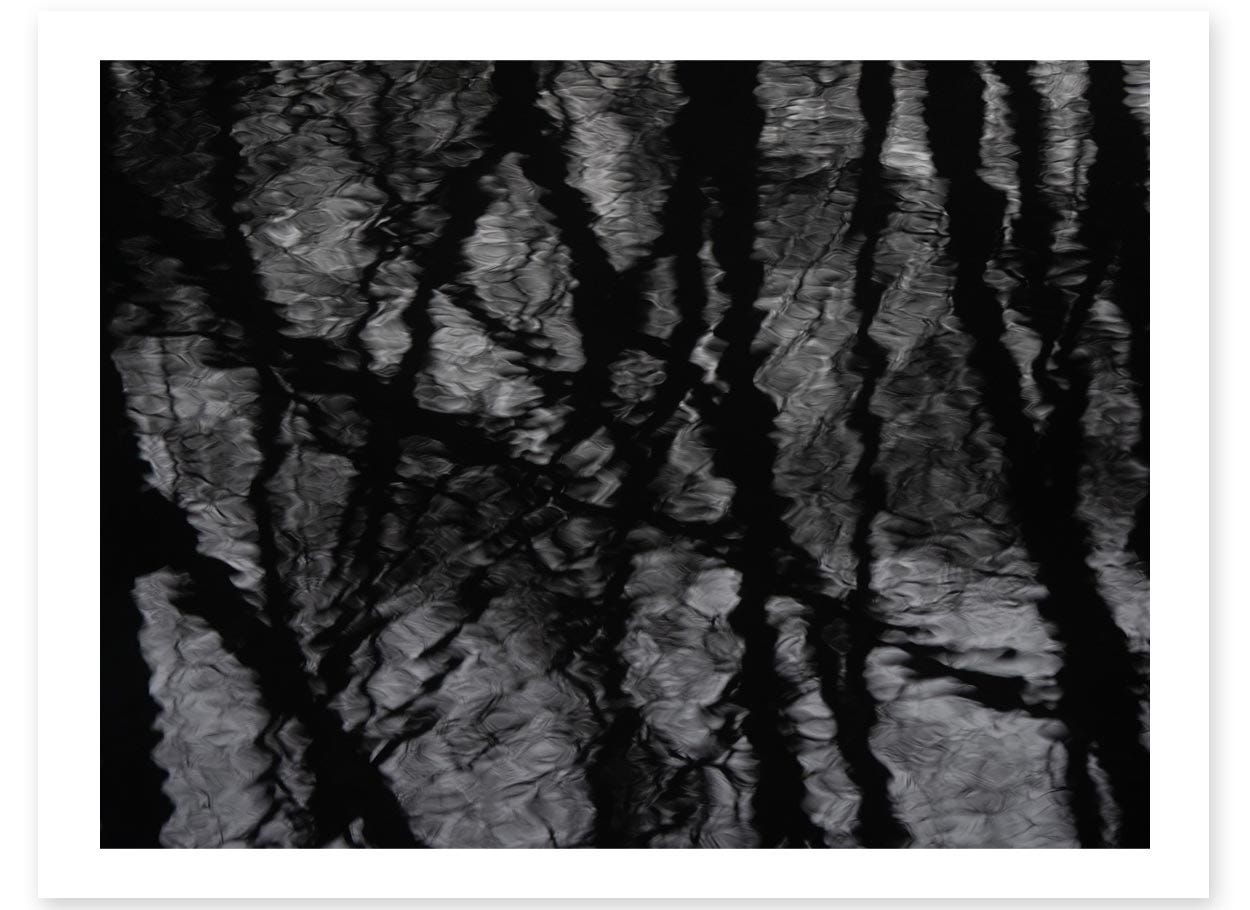
‘Not Black and White’
The shot above looks black and white.
It was taken at that dusky, mercurial time of day when the shadows are black and the water has just enough light to reflect, but nothing more. Nature’s charcoal sketch.
There is always time for Orwell
It’s just occurred to me all the pictures for this edit so far involve either the sun, the water and/or trees. I am a creature of the country now.
It’s time to invoke Orwell.
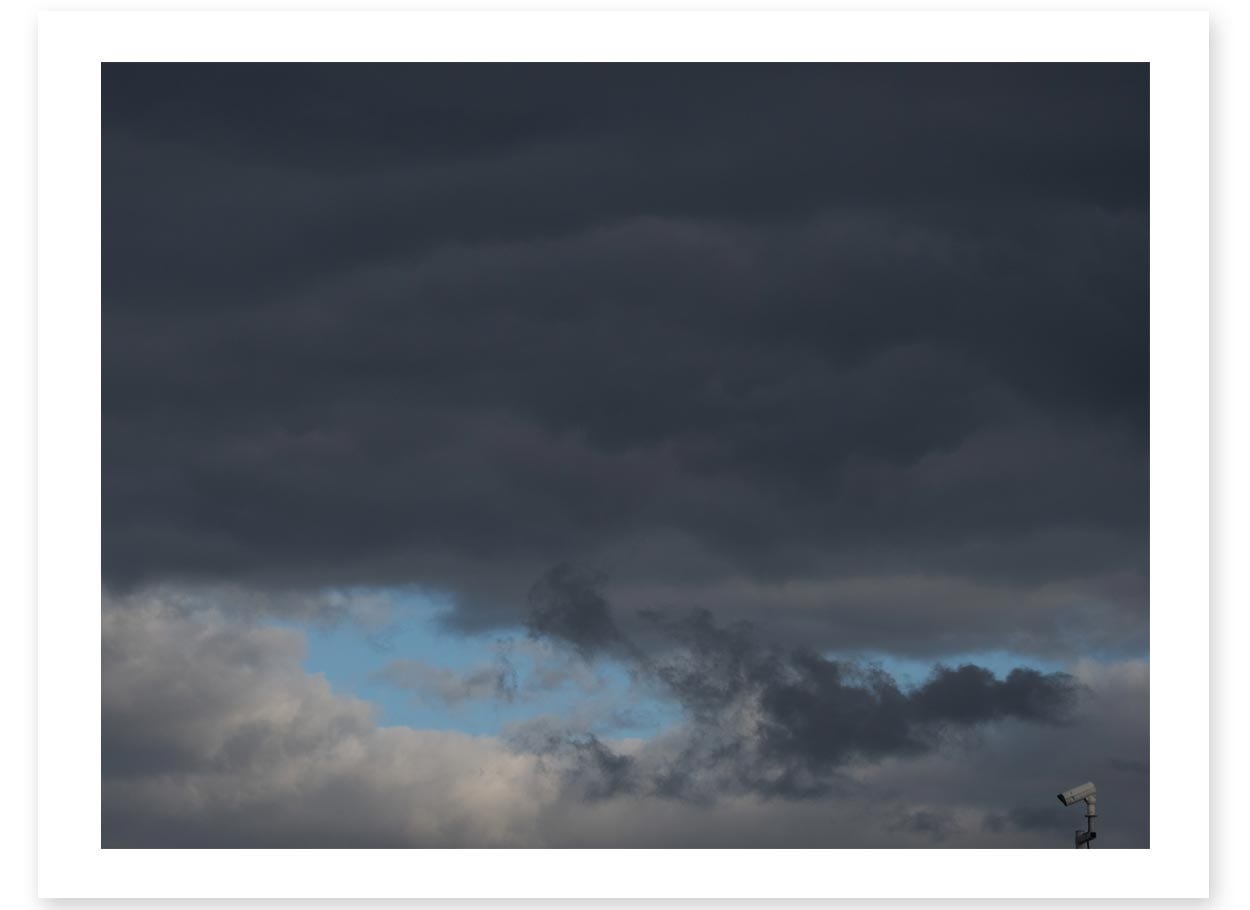
‘Small Brother is Clouding You’
This was taken on a happy day. A day with a couple of old friends in London walking along the Thames, trading stories.
They were draped over the waterside railings chatting while I spent a few minutes trying to isolate the CCTV camera against the ragey sky.
Talking about Orwell and 1984 feels like cliché territory but I ashamedly love his work and witchy foresight. So this shot is an ode to him. A storm in plain sight.
When the viewer is not physically with us at a scene we have to do the work for them to help them notice ‘the thing’. We have to show (or signpost) what attracted our attention.
In this case, for me, it was that oasis of blue in an oppressive, enclosing storm cloud. The dystopian state monitoring system standing sentry, coldly, implacably.
There were things below the camera, which I quite liked (some interesting angles) but I wanted to leave out everything that didn’t sing to the theme I was focussing on.
Using depth, light, colour or shape to accentuate a story
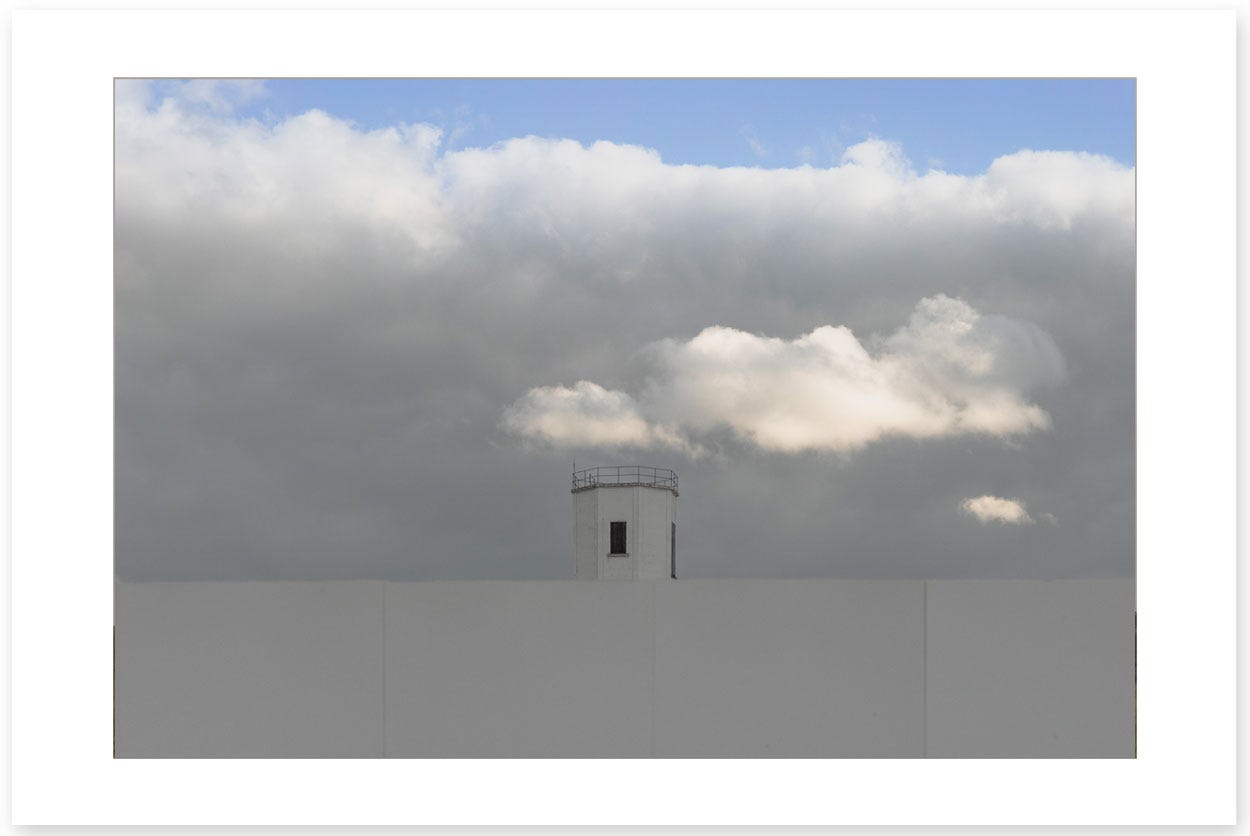
‘White Tower’
A little further along our walk I was weighing up whether I could respectfully sneak into a heavily fortified building site (I didn’t).
As I turned this oddly 3D, honeyed cloud emerged, like smoke from this tower. There was some white hoarding close to me (but far from the tower) so I used it to keep the colour palette simple.
If we are not framing, we are not really ‘seeing’. We’re doing something different. We’re excited by the moment and the scene before us. That’s a wonderful thing. That’s a happy moment and I try to put the camera down and enjoy these moments.
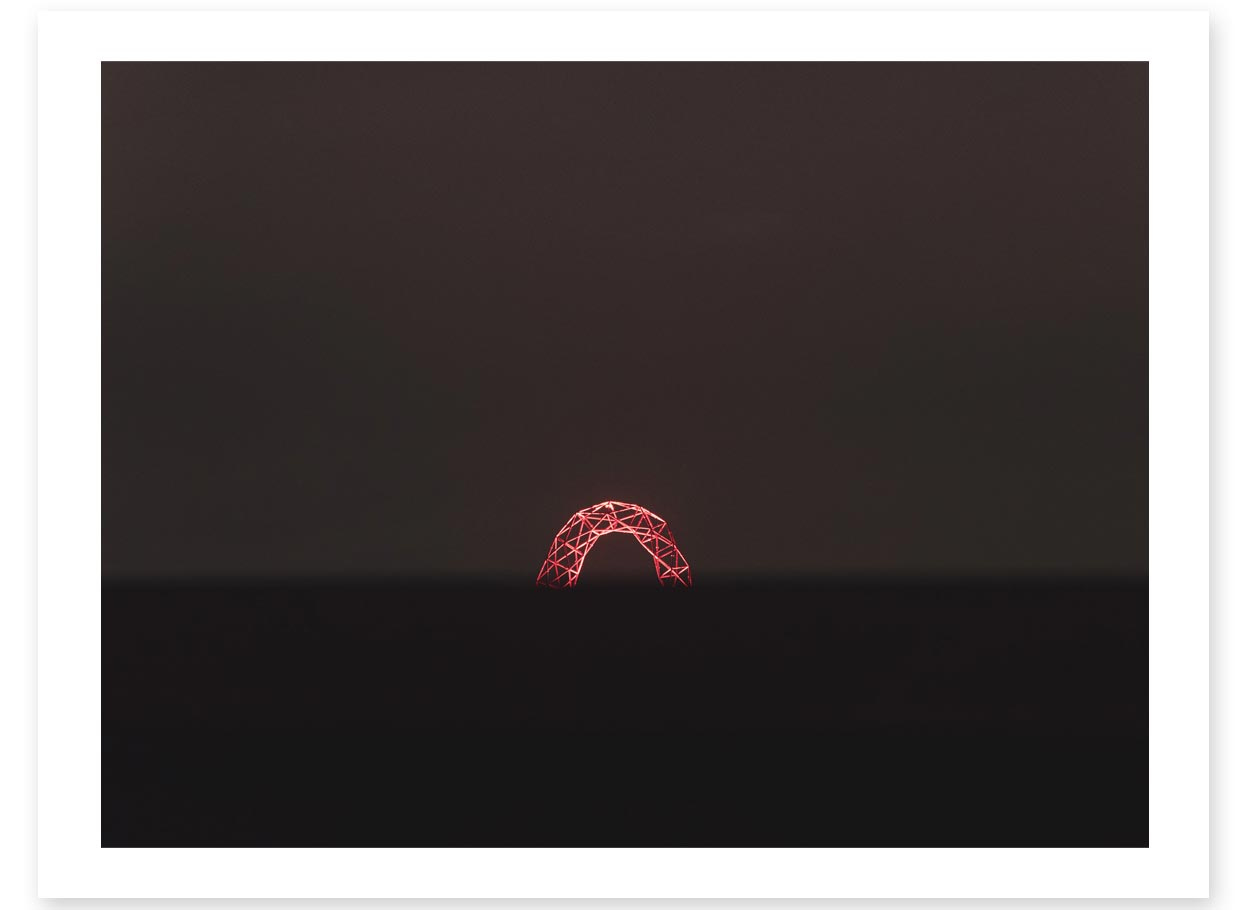
‘Orbiting Abstractions’
It feels appropriate to go full circle. A man-made sunset.
I’ve taken so many pictures of the Orbit over the years. It’s a London landmark which has been relatively close to places I’ve lived in East London since the 2012 Olympics.
I’m not sure about it. It has a rollercoaster vibe. I also think it looks a bit like a collection of industrial veins.
I’ve learnt to love it over the years, mainly because it peeps over things. I have hundreds of photos spanning what must now be over 15 years where the orbit is popping its head over something else.
In this photoset of abstractions I think it finds a place because it’s unclear what’s going on. The scale is unclear. Even what we're looking at, unless you are a Londoner, is unclear.
When we take elements out, the effect this has on the viewer is that it allows for some imagination.
It’s like the horror movie that instead of relying on gory, explicit scenes, suggests a tension and an unknown that leaves you with a sense of dread.
The viewer can mentally fill in what is going on around a scene.
Maybe it is a more beautiful, more infinite forest than shown in the confines of the image.
Maybe it is a perfectly cylindrical puddle.
There are infinite maybes and unknowns.
The lovely shared part to keep in any art form is to allow the viewer licence to add to the story.